The short answer
| In Zendesk | In Intercom | How it is handled |
|---|---|---|
| Ticket | Conversation, or ticket of the type you choose | One per ticket, created with its original date |
| Subject | Title | Carried as it is |
| Description | The opening message | In Ticket mode it also fills the ticket’s description |
| Public comment | Reply | Original time and author kept |
| Private comment | Internal note | Never shown to the customer |
| Requester | Contact | Matched on email or external ID |
| CCs | Participants | Added to the conversation |
| Assignee and group | Teammate and team | Mapped one by one |
| Status | Open, snoozed or closed, or a ticket state | You choose each value |
| Archived ticket (closed over 120 days) | Conversation or ticket, like any other | Carried with its full thread and original dates |
| Priority | Intercom’s own priority field | Value by value, as conversations |
| Type | A custom attribute | Value by value |
| Tags | Tags | Matched to existing tags, ignoring case |
| Custom ticket fields | Conversation or ticket type attributes | Field by field, values one by one |
| User and user fields | Contact and contact attributes | User or lead, as you choose |
| Organisation and organisation fields | Company and company attributes | Organisation ID as company ID by default |
This page is for the admin who plans the mapping. For what moves overall, and what you set up again in Intercom, see Zendesk to Intercom migration. For what to switch off before the first run, see the Zendesk to Intercom migration checklist.
The first decision: conversations or tickets
Before any field is mapped, choose how Zendesk tickets land in Intercom: as conversations, or as tickets of an Intercom ticket type. The choice decides which fields you can map to, so make it first.
- Conversations. Each ticket arrives as a conversation with its whole thread. Ticket fields map to conversation attributes. Conversation attributes cannot be created through Intercom’s API, so create the ones you need in Intercom before mapping.
- Tickets. Each ticket starts as a conversation carrying the thread and is then converted into the ticket type you pick. That adds the type’s attributes to the mapping and gives each record a ticket state. Missing ticket type attributes can be created from the mapping screen, but the ticket type itself is created in Intercom first.
Tickets suit work that takes time and needs a type and a state; conversations suit quick questions. If you are unsure, read Intercom tickets vs conversations. The mapping locks for the whole migration once a run completes, a completed Sample included, so settle this before the Sample. A failed or cancelled Sample locks nothing, and to change a locked mapping you clone the migration.
Zendesk ticket fields and where they land
| Zendesk ticket field | In Intercom | Good to know |
|---|---|---|
| Subject | Title | The conversation or ticket title. |
| Description | Opening message | In Ticket mode it also fills the description, which holds at most 32,766 characters. A longer one is cut there and named as a Vendor limit; the full text stays in the opening message. |
| Requester | The contact who opens the conversation | Intercom opens every conversation in its contact’s name, so a ticket an agent opened for a customer shows its first message as the customer’s, and the record says so. |
| CCs | Participants | Everyone copied on the email is added to the conversation. |
| Followers | Not added | Intercom has no followers on a conversation. The record names them. |
| Assignee | Teammate | Teammates must already exist in Intercom; its API cannot create them. Anyone missing falls back to a default you choose. |
| Group | Team | The team is assigned first and the teammate second, so Intercom’s round-robin does not replace the teammate you mapped. |
| Status | State, or ticket state | You map every value; see the status table below. |
| Priority | Intercom’s own priority field | Mapped value by value when you migrate as conversations. An Intercom ticket type has no priority field, so in Ticket mode priority is not mapped. |
| Type (question, incident, problem, task) | A custom attribute | Intercom tickets have no built-in Type. It travels only when you map it. |
| Ticket form | The ticket type you choose | Forms are configuration. Create matching ticket types in Intercom first. |
| Tags | Tags | Matched to your existing Intercom tags, ignoring case, and reused as they are, never renamed. |
| Created date | Created date | Each conversation and each reply keeps its original time. Intercom sets its own last-updated time when the record is written. |
| Due date (tasks) | Not carried | A conversation has no due date. The record keeps the original date. |
| External ID | Not on the conversation | Intercom conversations have no external ID. Map it to an attribute to keep it. |
| Channel (via) | Not carried | Intercom’s API creates every migrated conversation as an email conversation. |
Custom fields, type by type
Zendesk documents twelve ticket field types. Intercom attributes come in fewer types, so most map one to one and a few need a decision. Where the Intercom attribute does not exist yet, it can be created from the mapping screen for contacts, companies and ticket types; conversation attributes are created in Intercom first.
| Zendesk field type | Intercom attribute | Good to know |
|---|---|---|
| Text, and regular expression | Text | The pattern check stays in Zendesk; the value arrives as text. |
| Multi-line text | Multi-line text | Line breaks are kept on a multi-line attribute. |
| Checkbox | True or false | |
| Date | Date | |
| Number and decimal | Number and decimal | |
| Drop-down | List | Each value is mapped to an Intercom value one by one, with a fallback you choose. |
| Multi-select | No direct match | Intercom’s own Zendesk importer documentation says multi-select fields have to become text. Plan a text attribute, or a list holding the one value that matters, and check how it reads on a Sample. |
| Lookup relationship | No direct match | The same note applies: plan a text attribute and check it on a Sample. |
| Credit card | Leave unmapped | Zendesk keeps only the last four digits; there is rarely a reason to carry them. |
Two limits are worth knowing before you map people’s fields. Intercom refuses a list attribute on contacts or companies with fewer than two or more than 35 options, and the mapping screen tells you so by name before anything is created. A Zendesk drop-down with more values than that is mapped to a text attribute instead.
Statuses and priorities, value by value
Every value inside a field is mapped in writing to where it lands, with a fallback you choose. A value with no match and no fallback is left off and named as a Setup gap, never swapped for a guess.
Statuses decide whether each conversation ends up open or closed. The state you map each status to is applied exactly, and it is written last, after the replies and the assignment, because each of those reopens an Intercom conversation. In Ticket mode, the category of the ticket state you map to decides open or closed. A sensible starting point, which you can change value by value:
| Zendesk status | As a conversation | As a ticket (state category) |
|---|---|---|
| New | Open | Submitted |
| Open | Open | In progress |
| Pending | Open | Waiting on customer |
| On-hold | Open | In progress |
| Solved | Closed | Resolved |
| Closed | Closed | Resolved |
Map a status to Snoozed only if you want those conversations back: a snoozed conversation wakes after 7 days and reappears as open in the inbox.
Priority has a home of its own. When you migrate as conversations, each Zendesk priority maps to a value of Intercom’s own priority field, which takes Low, Medium, High and Urgent. An Intercom ticket type has no priority field, so in Ticket mode priority is not mapped. Type has no built-in home in Intercom, so it becomes a list attribute you create first, with values that match Zendesk’s.
| Zendesk field | Zendesk values | In Intercom |
|---|---|---|
| Priority | Low, Normal, High, Urgent | Intercom’s priority field, value by value, for example Normal to Medium (as conversations) |
| Type | Question, Incident, Problem, Task | A list attribute, for example ‘Zendesk type’, with the same four values |
Users to contacts
- User or lead. Zendesk end users become Intercom users or leads, as you choose in the mapping. An Intercom user needs an email or an external ID; a lead needs neither, but Intercom will not store an external ID on a lead.
- Matching. Contacts are matched on email or external ID, never on name or phone, so two people who share a name are never merged.
- No email and no external ID? The contact gets a stable ID from the source, so a later run finds it again instead of creating a second one.
- Archived in Intercom? A matching archived contact is unarchived and updated, not created again.
- Dates. Intercom has no writable created date for a contact, so the Zendesk creation date goes into the contact’s signed-up date.
- Phone numbers. If phone number validation is on in Intercom, numbers it cannot validate are refused. Turn it off for the run.
- User fields. Each maps to a contact attribute: text, number, decimal, true or false, date or list. Missing ones can be created from the mapping screen.
- Agents. Zendesk agents are not contacts. They map to Intercom teammates, who must exist before mapping.
More on keeping one person as one contact: avoid duplicate contacts in an Intercom migration.
Organisations to companies
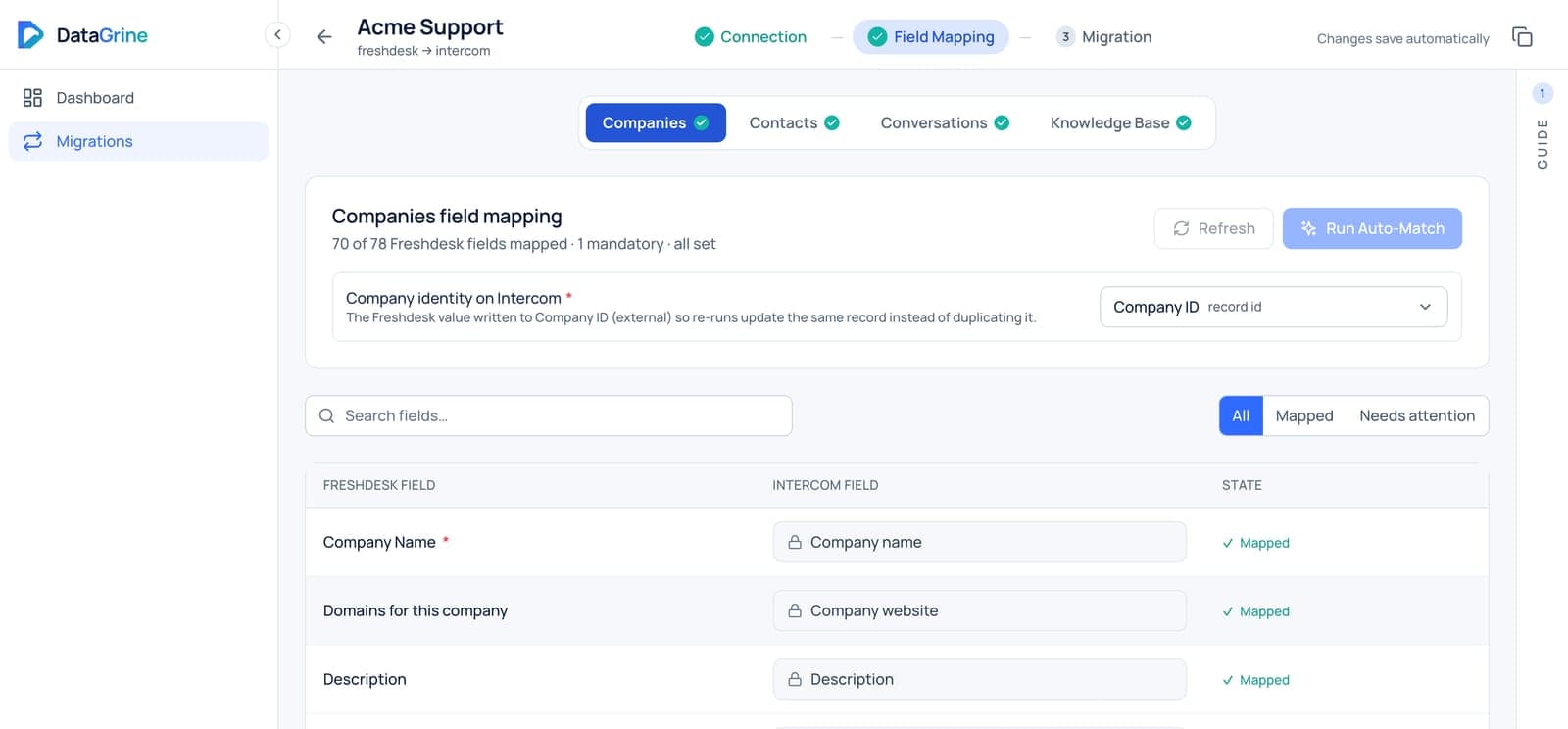
- The company ID. Intercom identifies a company by its company ID alone, and the ID cannot change later. By default it receives the Zendesk organisation ID, so a re-run updates the same company rather than adding a second. If you choose another field, it must be unique: two organisations sent with the same ID become one company.
- A company Intercom already holds. A write with an ID Intercom already has updates that company. It is counted as an update, and a rollback leaves it in place.
- Visible once it has people. Intercom shows a company once at least one contact is attached to it.
- Organisation fields. Each maps to a company attribute, with the same types as contact attributes. Missing ones can be created from the mapping screen.
What cannot map, and the honest workaround
Nothing here disappears silently. Each of these is named on its record and counted in the Reconciliation report, as a Vendor limit, a Setup gap or Not carried. What you can plan is where the information lives afterwards.
| In Zendesk | Why it has no place | The workaround |
|---|---|---|
| Type field | Intercom tickets have no built-in type | A list attribute, or a ticket type per kind of work |
| Multi-select and lookup fields | No matching attribute type | A text attribute, checked on a Sample |
| Drop-downs with more than 35 values (people) | Intercom refuses longer lists on contacts and companies | A text attribute |
| Ticket external ID | Conversations have no external ID | Map it to a text attribute |
| Followers | Intercom has no followers | None in Intercom; the record names them |
| Due dates on tasks | A conversation has no due date | Set reminders again for open tasks; the record keeps the date |
| Original channel | Every migrated conversation is created as email | Keep a Zendesk export if you report on channel |
| Inline image position | Image links expire | The image arrives as a file on the same message |
| Very long descriptions | A ticket description holds 32,766 characters | The full text stays in the opening message |
| Satisfaction ratings | Intercom’s API cannot write a past rating | Keep the Zendesk report |
| SLA history and ticket metrics | Read-only in Zendesk | Keep the Zendesk report; set up SLA rules again in Intercom |
| Side conversations | Not part of the ticket thread the migration reads | Export any you need before you close Zendesk |
Check the mapping on a free Sample
The Sample is free: 20, 100, 500 or 1,000 of your own tickets (100 by default), with the users and organisations they use. Sample records are real records in Intercom, and the Full migration recognises them instead of creating them twice. Pick tickets that test the mapping, then open them in Intercom and check:
- Each mapped attribute holds the value you expected, including your drop-downs and any multi-select you sent to text.
- Solved and closed tickets arrived closed, and open ones open, as your status map says.
- Each conversation shows the Intercom priority you mapped, and Type sits in the attribute you made for it.
- Tags match your existing Intercom tags, with no near-duplicates.
- People copied on emails are participants, and private comments are internal notes.
- Contacts have the right company, and no contact arrived twice.
Then start the Reconciliation report for the run: it compares Zendesk and Intercom line by line and names every record that did not arrive as it was, with the reason. If the mapping needs a change after a completed Sample, clone the migration and fix it in the copy. When it is right, run the Full migration from the Zendesk to Intercom migration page.
Next step
Check a Sample migration of your own records in the new helpdesk before anything else moves, then run the full migration and a delta at cut-over.
Sources
- Zendesk Developers - Ticket fields
- Zendesk Developers - Tickets
- Intercom Help - Import your Zendesk ticket, user and organization data
- Intercom Help - Tickets explained
- Intercom Help - How to set up ticket types
- Intercom Help - Conversation data attributes
Vendor facts checked against these pages on . Vendors change their products; if something here has moved, tell us and we will correct it.